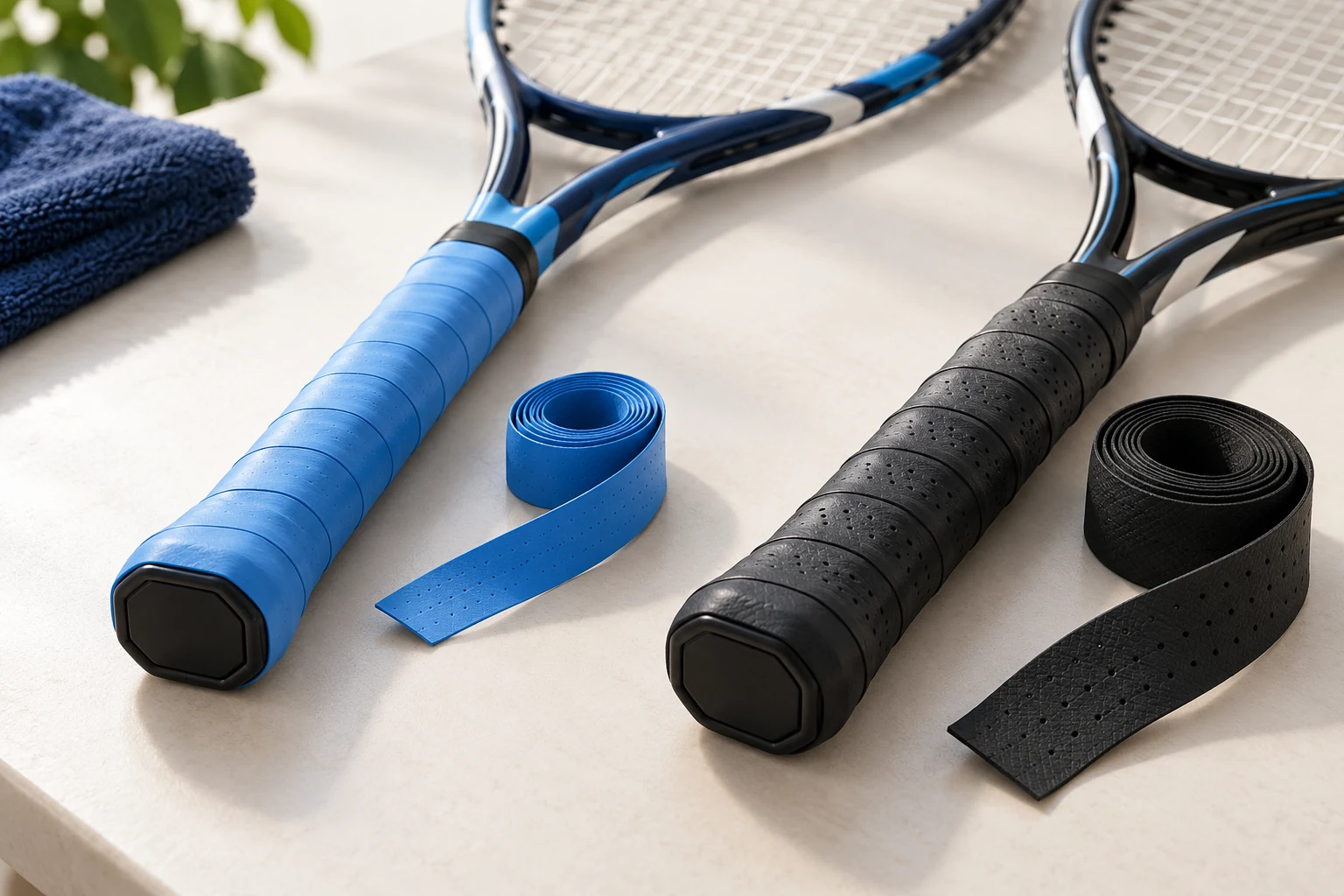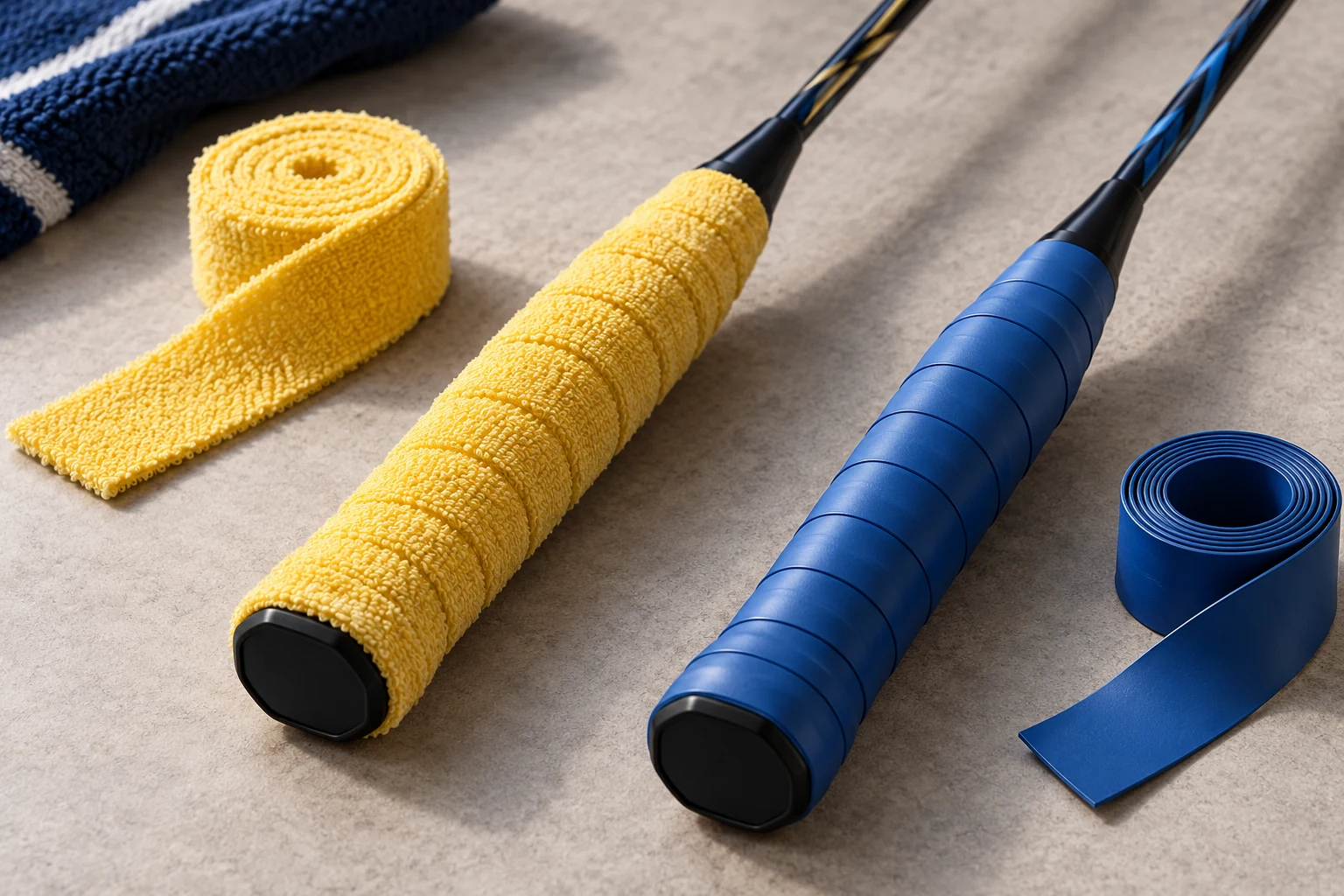
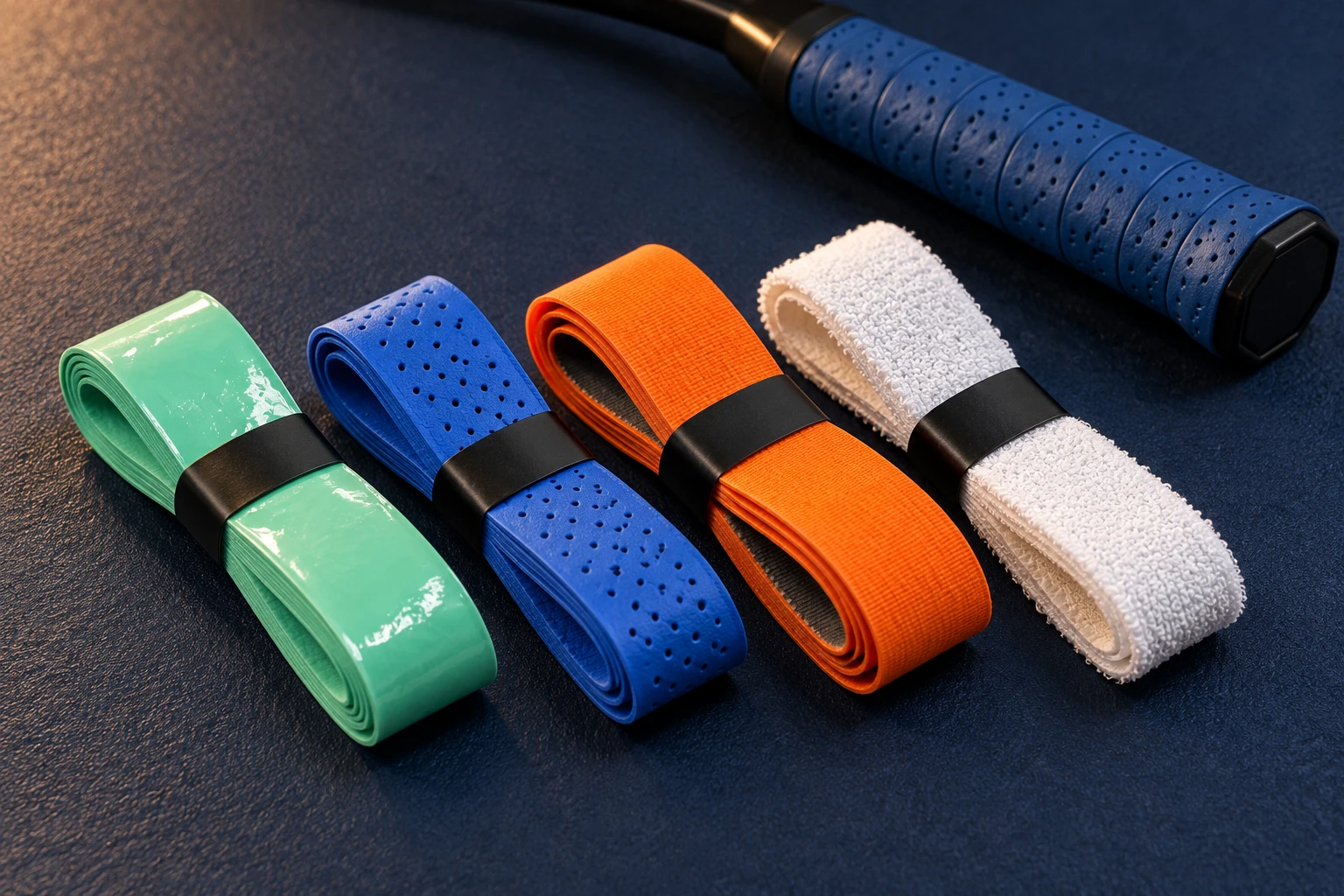
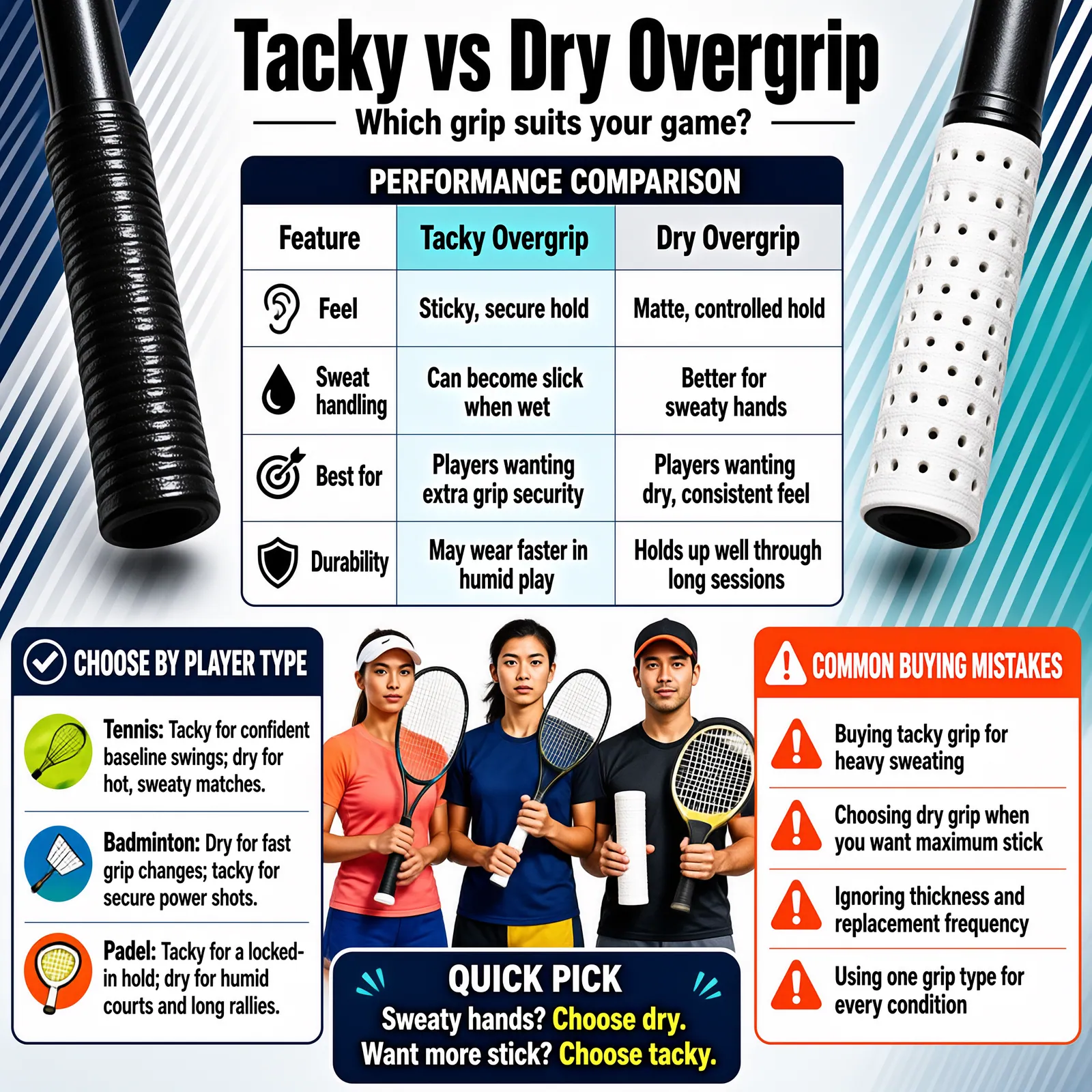
Tacky vs dry overgrip describes a surface-feel choice. A tacky wrap has a more adhesive feel, while a dry-feel wrap is less sticky. Neither label alone establishes its material composition, moisture uptake or useful life.
For a product shortlist, separate the surface label from the construction specification. Record the actual model, material, dimensions and supplied format, then compare installed samples. Sweat evaluation and replacement planning are separate decisions covered by the linked guides.
A surface label is a starting description, not a complete material or performance specification.
Material and surface takeaways
- Tacky and dry describe surface feel; they are not complete material specifications.
- A dry-feel overgrip is not automatically woven cotton, and PU constructions can have different surface treatments.
- Compare the selected thickness and installed overlap on the same base grip.
- Use model specifications and physical samples rather than a universal sport or climate rule.
Tacky vs Dry: Define the Surface Before Selecting a Model
Start by describing the feel you want: adhesive contact, a less sticky surface or an intermediate feel. Ask for the composition and finish of the proposed model rather than treating the commercial label as a technical standard.
How a wrap feels depends on its surface treatment, supporting layers and installation. Two products sold as tacky can differ in compressibility and texture. Compare samples with the same base grip and wrapping method before approving either.
This guide does not provide a measured lifetime ranking. We do not have a documented comparison supporting a fixed number of sessions for tacky or dry models; use your own sample observations for the intended application.
What the Material Specification Should Tell You
Request the material description for the actual SKU, including any backing, cushioning and surface treatment. A tacky wrap may use PU, but the term dry does not prove a cotton construction. Towel grips are a separate textile format.
Surface texture and material composition are different fields. Smooth, perforated and raised-ridge versions can feel different even when their catalogue material labels are similar. Keep the material reference and surface reference together in the approved specification.
Catalogue dimensions help establish a shortlist, but they do not replace a measured sample. Confirm the variant, unit of measurement and acceptable tolerance with the supplier. Do not infer factory consistency from an unverified batch-test claim.
Compare Surface and Construction on Equal Terms
The table below identifies what to inspect on each sample. It is a comparison checklist, not a scorecard showing that one surface always wins. Record the approved SKU beside your observations so the decision can be repeated.
Keep the handle, base grip, overlap and wrapping tension consistent. A change in installed thickness can change the perceived feel even when the outer surface is unchanged. Evaluate surface contact separately from cushioning and final handle size.
| What to inspect | Tacky-feel sample | Dry-feel sample |
|---|---|---|
| Initial surface feel | Record adhesive contact | Record less-sticky contact |
| Moisture response | Evaluate the actual sample | Evaluate the actual sample |
| Replacement record | No fixed cycle assumed | No fixed cycle assumed |
| Installed feel | Check base layer and overlap | Check base layer and overlap |
| Edge finish | Review attachment and finishing | Review attachment and finishing |
| Thickness | Confirm the selected variant | Confirm the selected variant |
| Use conditions | Record intended conditions | Record intended conditions |
No comparative test dataset is asserted here. The labels and observations in this table are starting points for evaluating real samples; moisture response, wear and replacement timing must be established for the selected models and conditions.
Compare labelled samples on the same handle before approving a material reference.
Keep Moisture Evaluation Separate from the Surface Label
If sweat response is important, first shortlist the required surface and dimensions, then evaluate those samples during the intended use. A dry-feel label does not guarantee absorption, and a tacky sample should not be rejected solely because of its label.
Record how the contact surface feels before and after play, including whether wiping changes the result. Keep the selected material identity with that record. See the linked sweat-and-climate guide for a trial method rather than a universal winner.
Previously stated friction-loss percentages and laboratory sample sizes are not supported by a reviewable test record. They have been replaced with a practical sample-comparison method, without presenting a new numerical performance claim.
- If the racket moves in the hand, record the surface condition and installed fit before changing the material.
- If a surface feels slick, compare a fresh installed sample under the same conditions.
- If residue appears, photograph it and request material-specific care guidance rather than assuming its cause.
- If an edge lifts, check the overlap, tension, finishing strip and sample condition.
Check Construction on the Intended Racket
Tennis and Padel: Handle Build-Up
For tennis and padel, compare the outer wrap with the base grip already installed. Confirm the covered length, final circumference and finishing method; surface feel alone does not establish the correct thickness for every player.
An overgrip normally sits above a replacement grip. If a different layering arrangement is intended, specify it in the sample brief rather than assuming that tackiness from a lower layer will remain available at the hand-contact surface.
Badminton and Squash: Handle Reference
For badminton and squash, include the actual handle reference and the intended layer arrangement. Compare PU overgrips and textile formats as separate material options, and record the installed dimensions rather than assigning a single thickness to the sport.
Use the same wrapping method when comparing alternatives. If a sample changes the player’s hand position or finger clearance, record that installation effect separately from the surface preference so the next sample brief is precise.
Pickleball and Shared Equipment: Supplied Format
For pickleball, check the handle length, end treatment and position of the finishing strip. Select a supplied strip length that can cover the intended handle with the agreed overlap, then review the installed feel.
For shared equipment, agree a care and replacement process suitable for the selected material. Storage and cleaning instructions must come from the product reference; do not assume one material is heat-resistant or UV-resistant without supporting information.
| Equipment reference | Comparison option | Dimension check | Reason to record it |
|---|---|---|---|
| Sweat-sensitive application | Include a dry-feel sample | Check the selected model | Compare the actual surface response |
| Dry-hand preference | Include a tacky-feel sample | Check the selected model | Confirm the preferred initial feel |
| New product range | Compare labelled alternatives | Use a common handle reference | Separate material from installed size |
| Shared equipment | Agree care and handling | Confirm supplied length | Keep installation repeatable |
| Private-label project | Approve a material reference | Agree exact variant and unit | Connect sample approval to the order |
The useful outcome is a model shortlist with a clear material and installation reference. A club or shop can then evaluate moisture response and reorder requirements using that shortlist instead of selecting a material from a fixed climate threshold.
Keep Material Selection and Cost Planning Distinct
The material choice should first meet the intended use. Once samples are acceptable, compare quotations using the same supplied unit, dimensions, packaging and order specification. A low strip price does not establish the cost of a wrapped handle.
A cost comparison requires your own purchase and replacement records. Keep material selection in this guide and use the linked replacement-planning article for the calculation method. No universal price or usable-hour advantage is assumed for either surface.
Ask which items are included in the quotation and which require separate approval. Changes to the selected material, artwork or pack format may change the quoted terms. Treat a forecast as a planning assumption until real records are available.
- Compare prices for the same supplied unit and specification.
- Record replacement reasons for the exact selected model.
- Separate edge-installation problems from surface-wear observations.
- Confirm material-specific storage and handling guidance.
- Include relevant packing and delivery costs in your own procurement calculation.
Approve a Reviewable Material Reference for Supply
Surface and Dimension Reference
Retain a labelled approved sample with its model and variant. Agree the relevant material and dimension checks before ordering; a supplier’s general process description is not evidence of a particular batch result.
Ask how the agreed specification will be checked during supply and how deviations will be handled. Record the agreed approach rather than publishing unsupported claims about coating variation or inspection frequency.
Edges, Overlap and Finishing
Review edge shape and end treatment on the installed sample. The correct finishing method depends on the material and equipment. A material should not be described as immune to peeling or fraying without appropriate evidence.
Confirm how wrapping tension and overlap should be controlled for the reference installation. Do not assign an unverified stretch threshold to all products; record the method used when the sample is approved.
Material, Artwork and Order Brief
Standard products start at 100 units, with up to two colors. Custom projects currently start at 1,000 units; confirm the applicable minimum, model combinations, color quantities and supplied unit in the quotation rather than assuming a per-color minimum.
Samples, artwork review, packaging and order timing are confirmed against the selected brief. Do not assume a fixed number of revisions or additional weeks for a particular material without a project-specific schedule.
Keep the approved material, installed reference and packing specification together. Agree any inspection criteria with the supplier and request records when measured performance is material to your decision; no comparative laboratory results are claimed in this guide.
Material and Surface Questions
What does tacky or dry actually describe?
These terms mainly describe the surface feel. Confirm the model’s material composition, treatment and installed thickness separately; a dry-feel label does not automatically mean a woven textile construction.
Does the material label establish service life?
No. Replacement timing depends on the selected model, installation, use and care. Compare records for the actual samples rather than assuming a fixed lifetime ratio between tacky and dry products.
Where should I evaluate a sample for sweaty hands?
Use the linked sweat-and-climate guide to record the conditions, installation and surface observations. It is a separate evaluation from identifying the material and should be performed on the intended equipment.
Does a surface label tell me when to replace a wrap?
No. Inspect the installed wrap and record the reason for replacement, such as lifting edges, visible damage or unacceptable handling. Follow the selected product’s care and replacement guidance.
Can an overgrip sit above a replacement grip?
That is a common layer arrangement. Confirm compatibility and final handle dimensions on the intended equipment; the lower layer’s surface properties should not be assumed to pass through the outer wrap.
How should I select thickness?
Start with the model dimensions and compare the installed result on a fixed handle reference. There is no single thickness that establishes comfort for every player, sport and overlap method.
Can a material be guaranteed to prevent skin discomfort?
No material label establishes that guarantee. If a sample causes discomfort, stop using it and reassess the fit, installation and surface before selecting another option. Do not use general marketing claims as a personal suitability test.
Keep material identity, sweat evaluation and replacement planning as separate, connected decisions.
Prepare a shortlist that identifies the required surface, material, dimensions and supplied format. Link each sample to a clear installation reference, then use the related guides for sweat evaluation and replacement planning. Request a quotation only after the remaining specification questions are clear.