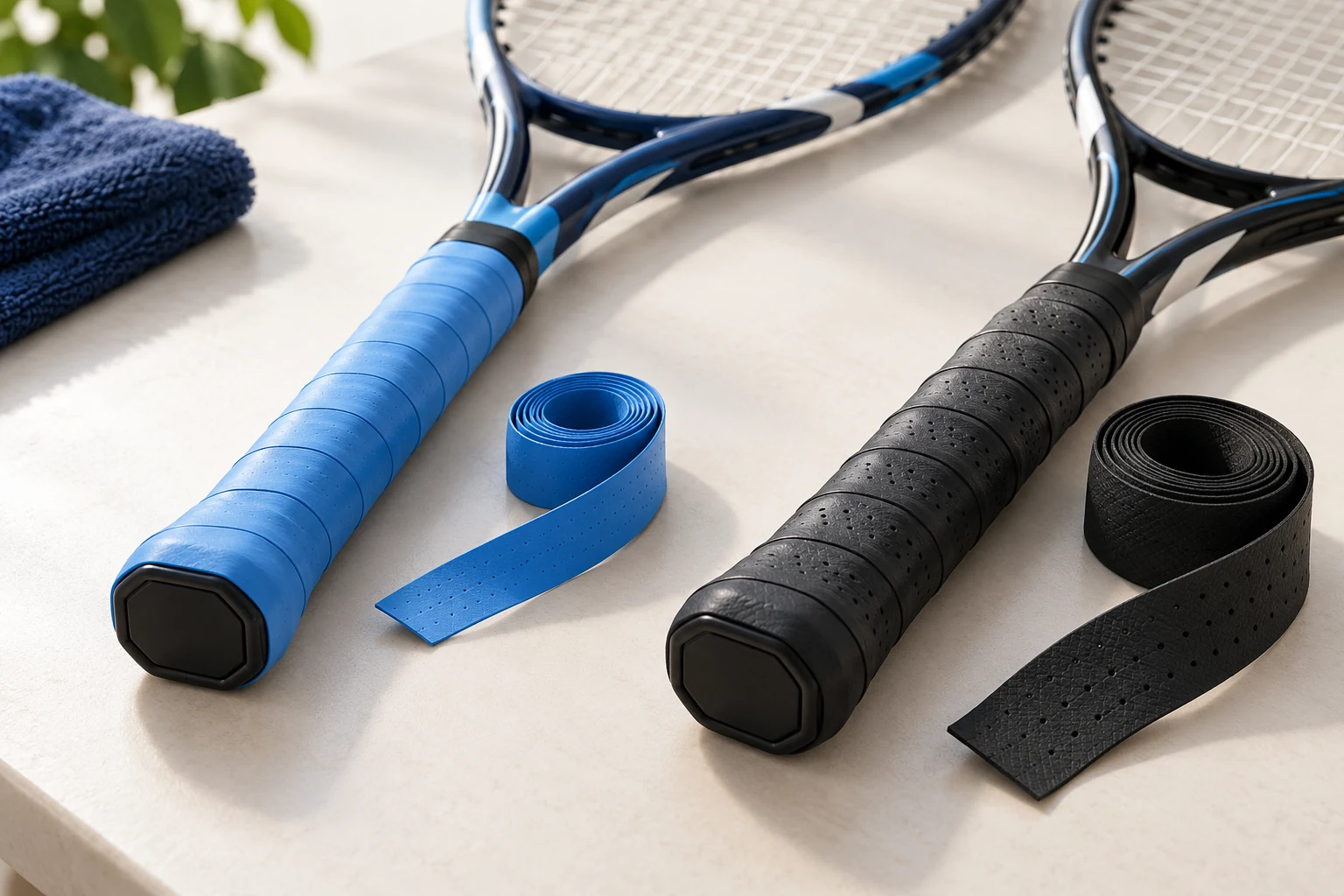
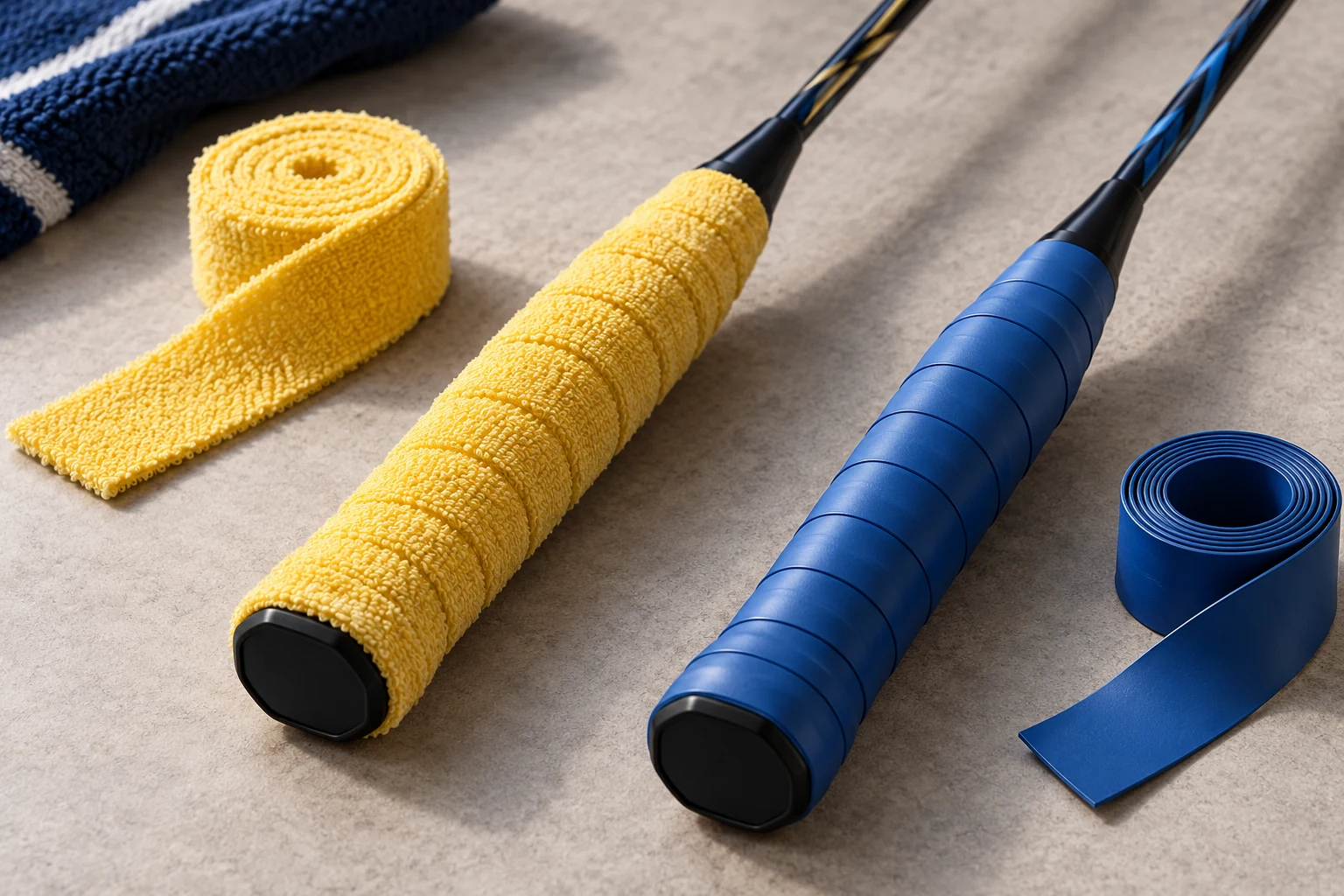
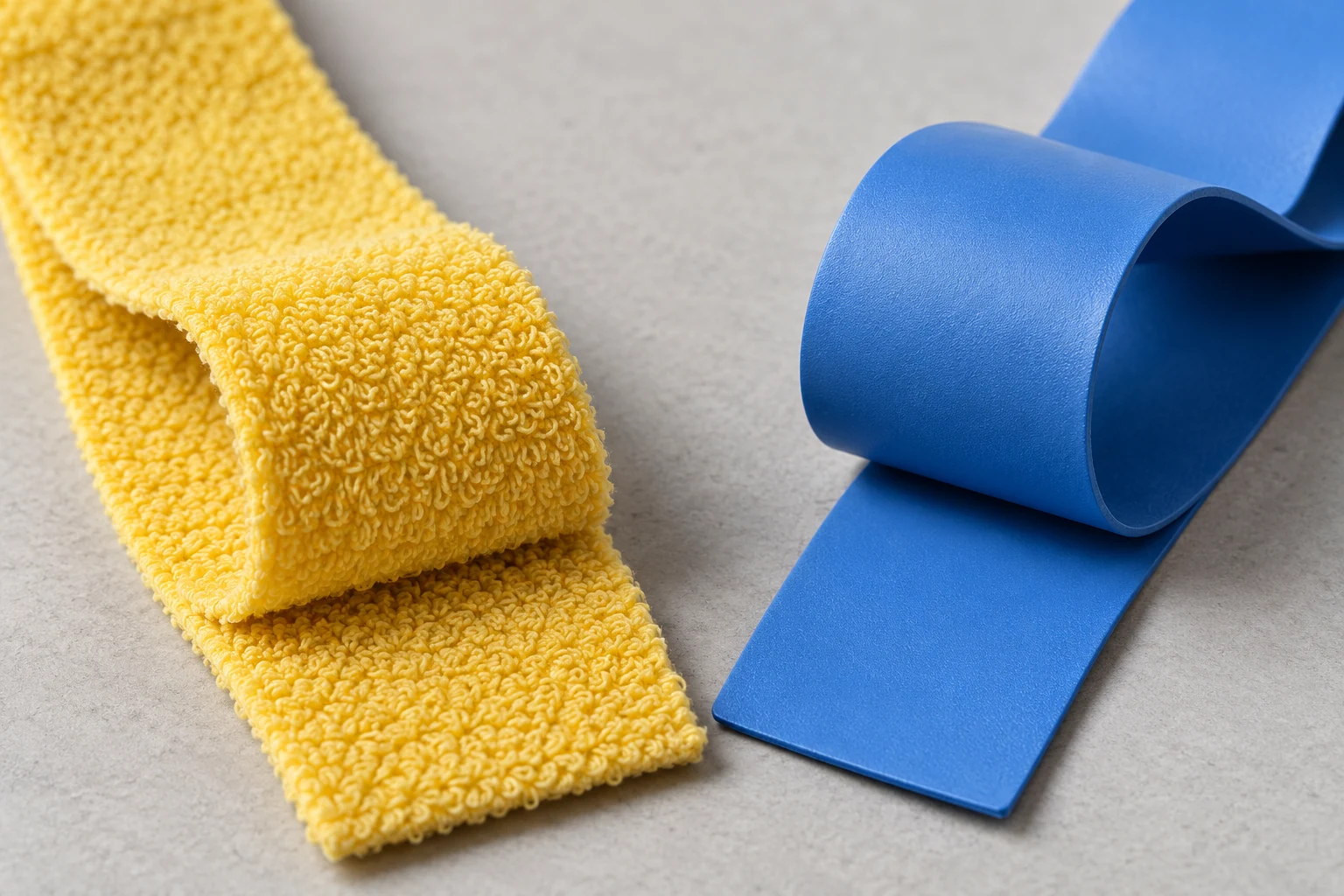
A towel grip provides a textile-pile contact surface; a PU grip uses a polyurethane-based surface that may be tacky, dry, smooth or textured. For badminton, choose by the installed feel, finished handle size and maintenance routine you want. Confirm material composition and sample the exact construction rather than assuming one surface suits every sweaty hand.
“Towel or PU?” is often presented as a simple contest. For a player, it is a question about hand-feel and fit. For a brand or distributor, it also involves fiber claims, roll versus individual-wrap formats, packaging and repeatable specifications. This guide explains the choices using the towel and PU models currently listed by Tackavo.
What is the difference between towel grip and PU grip?
A towel grip has a textile surface with a raised pile. A PU grip has a polyurethane-based construction, and its finish can vary between models. These names describe different things: “towel” describes a surface structure, while “PU” identifies a material. Neither term alone establishes the backing, complete composition or layer arrangement.
| Selection question | Towel grip | PU grip |
|---|---|---|
| What touches the hand? | Textile pile with a towel-like texture | A smooth, sanded, perforated or raised-ridge surface, depending on the model |
| Is the composition fixed? | No; confirm cotton, polyester or another declared composition | Confirm the complete construction; some entries identify additional materials |
| How is feel selected? | Compare pile texture, compression and the installed handle | Compare tack level, surface texture, flexibility and installed fit |
| Which format is available? | Continuous rolls and individual wraps in the current Tackavo range | The cited Tackavo overgrip models use individual cut lengths |
| What needs care? | The textile surface, drying between use and the backing | The surface finish, edges and any adhesive or finishing tape |
| What should branding specify? | Suitable wrap, finishing-band or packaging presentation | Suitable strip, band or packaging logo placement for the selected finish |
A cotton claim should come from a confirmed composition, not from a towel-like photograph. As an industry example, Yonex's badminton towel grip listing explicitly identifies cotton. That is a specification for its product, not evidence that every towel grip is cotton.
Which surface should you try for sweaty hands?
Start with a sample comparison, not a blanket “towel is better” or “PU is better” claim. Record how the grip feels at the start, during representative play and afterwards. Surface feel, moisture handling and drying are separate observations. Without a defined test and comparable results, a generic material name cannot establish which model absorbs more or lasts longer.
A towel grip is a sensible sample candidate when the brief calls for textile contact and a pile surface. A smooth PU overgrip is a candidate when the brief calls for a flatter wrap or a particular tack level. Within PU options, a dry-feel grip and a tacky grip should not be treated as the same hand-feel merely because they share a material family.
For a Tackavo comparison, start with OG-TW03 cotton towel grip, OG-T01 soft tacky overgrip and OG-D01 dry overgrip. Specify the exact PU thickness before sampling. Since the towel model's listed dimensions differ, review surface preference and finished handle size as separate questions.
For maintenance, follow the care and adhesive guidance supplied for the selected product. Allow a damp grip to dry before enclosed storage, and inspect the surface and backing before reuse. Do not assume that a self-adhesive towel wrap can be machine washed or that a PU coating tolerates solvents. Confirm the cleaning method if a washable product is part of your customer brief.
How do Tackavo's three towel-grip models differ?
The current range offers three starting formats with different dimensions. The table reproduces the listed measurements and converts centimetres to millimetres for easier comparison. Textile thickness can depend on the measurement method, so confirm how the selected sample is measured before finalizing a production tolerance.
| Model | Listed material | Listed dimensions | What to confirm |
|---|---|---|---|
| OG-TW01 | Polyester super-fiber | Approx. 10 m × 3 cm × 0.4 cm; equivalent to 10000 × 30 × 4 mm | Full-roll or cut-piece ordering unit, approved cut length and thickness measurement method |
| OG-TW02 | Towel fabric; fiber composition not specified | Approx. 70 cm × 3 cm × 0.35 cm; equivalent to 700 × 30 × 3.5 mm | Handle coverage, composition and chosen backing |
| OG-TW03 | Cotton; self-adhesive backing listed | Lengths 750 / 1100 / 1200 mm; widths 25 / 27 / 30 mm; thickness 1.5 mm | Available length/width combinations and required packaging |
OG-TW02 should not be labeled cotton or microfiber until its composition is confirmed. OG-TW01's super-fiber description also should not be used as a cotton claim. Keep the product page, quotation and packaging wording aligned with the material selected for the actual order.
Does a towel grip make a badminton handle thicker?
The finished handle depends on the grip thickness, the layers underneath and the wrapping method. A towel's pile can compress under the hand, so its flat dimension cannot be translated directly into a precise installed grip size. Compare the complete setup on the intended handle, not only a short loose fabric sample.
The current flat Tackavo PU overgrip entries commonly list 0.4–0.8 mm, while the three towel entries above list different profiles. Those are model specifications, not proof that all towel grips are thicker than all PU products. A raised-ridge construction may also have a local profile that differs from the surrounding tape. For example, Yonex's Wave Grap Pure specification identifies polyurethane and natural rubber with a variable thickness profile.
Check length as carefully as thickness. OG-TW02's 700 mm format needs a coverage trial on the intended handle; OG-TW03 offers several listed lengths. More overlap uses more material and changes the wrap. If you are uncertain about the starting layers, read the overgrip versus replacement-grip guide before defining the sample setup.
Should a brand buy towel grip rolls or individual wraps?
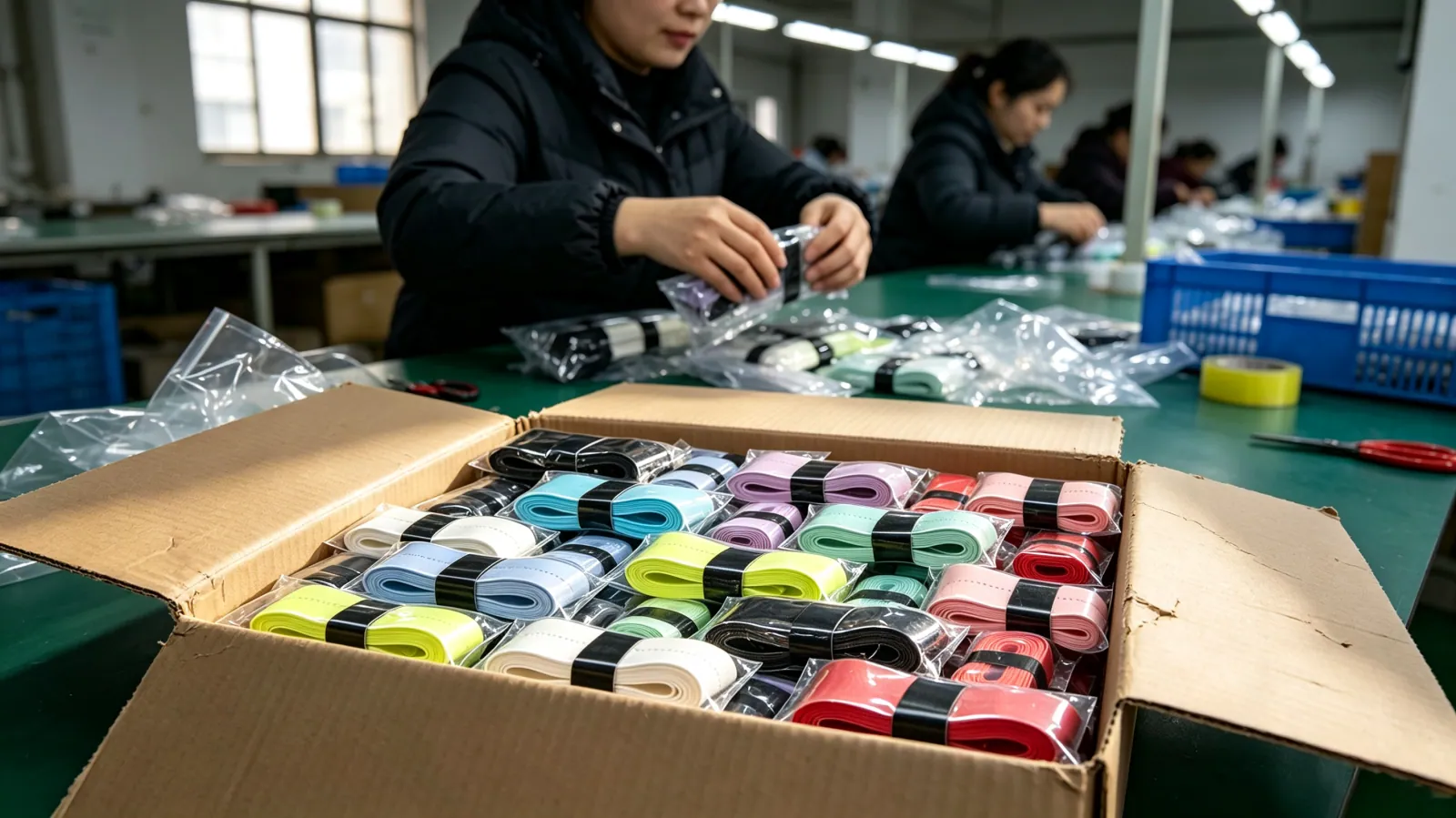
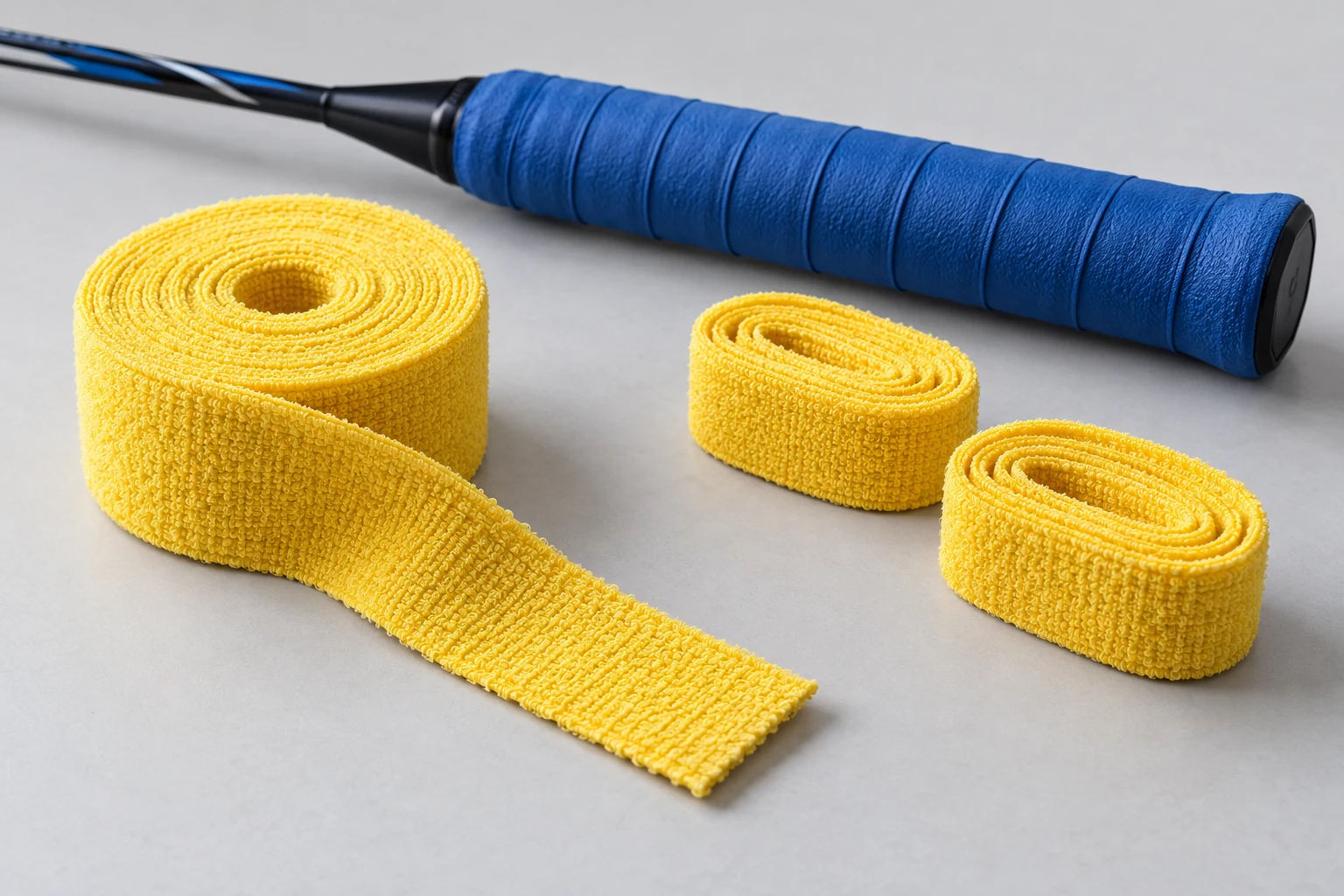
Choose the format around the way you will cut, pack and sell the grip. A continuous roll can suit racket-service counters or a repacking operation. An individual wrap can suit a ready-to-use retail unit. Neither format is automatically cheaper once cutting, handling, waste and packing are included.
Continuous rolls
State the full roll length, required usable length, width, textile thickness and any cutting service. Agree whether the quotation counts rolls or finished pieces. Dividing 10 m by a proposed cut length is a planning estimate; trimming and handling allowances still need to be specified. Do not print a guaranteed number of wraps per roll without an approved cutting plan.
Individual wraps
Specify the finished length, width and backing, plus pieces per retail pack. Test the wrap on the intended handle before approving pack artwork that promises coverage. OG-TW03 lists OPP bags, zipper bags, plastic cans and blister-card formats; confirm which formats are available for the selected model and quantity rather than applying that list to every towel product.
How should you compare samples for a private-label range?
Use a short evaluation sheet with two separate sections: installed performance observations and commercial requirements. This keeps a preferred surface from being confused with a packaging or length decision. Give each evaluator the same reference handle and a clearly labeled sample.
- Confirm the identity. Record SKU, material statement, dimensions, color, backing and whether the sample is a cut piece or a full roll.
- Document installation. Note which base layers remain, the overlap pattern, finishing method and coverage. Photograph the finished grip.
- Compare feel under representative use. Record the user's surface preference, grip circumference, hand repositioning and after-use condition. Keep the conditions consistent.
- Review branding and pack contents. Decide where the logo will appear and whether the pack describes a roll, one wrap or multiple pieces.
- Close the specification. Confirm any requested changes, retain the approved sample and use the same specification on the quotation and label.
For an OEM brief, send quantities by model and color, the destination, artwork and required packaging. Tackavo's current starting minimums are 100 units for standard products, with up to two colors and 1,000 pcs for custom products or logo programs. Confirm the ordering unit and variant allocation, particularly for rolls. Sample selection, availability, quantity, charges, shipping and preparation timing are confirmed before dispatch.
Available customization options include colors, dimensions, logo presentation and packaging discussions. The selected textile and finish determine the appropriate branding method. Approve a physical sample rather than assuming that a print designed for a smooth PU strip will reproduce identically on a pile surface.
Common questions about badminton towel and PU grips
Are all towel grips cotton?
No. Towel describes the texture. The current Tackavo range lists a cotton model, a polyester super-fiber model and one towel-fabric model whose fiber composition still needs confirmation. Use the model's material specification for retail labeling.
Is a PU grip always sticky?
No. The PU overgrip range includes tacky, mild-tack and dry-feel models. Review the specified finish and compare samples; material alone does not establish tack level.
Can I wrap towel grip directly on a handle?
Layer choice depends on the selected product and the finished size you want. State whether the sample will be fitted to a bare handle or over a base grip. Confirm backing, start/end method and coverage before approving that arrangement.
Which option lasts longer?
The current listings do not provide a controlled towel-versus-PU service-life comparison. Durability depends on the chosen model, use, maintenance and replacement criteria. Evaluate the options under the same conditions before making a quantified lifespan claim.
Should I sell both types?
Both can be considered if your customers have different surface preferences. Start with a small, clearly differentiated assortment and collect feedback on actual samples. Keep each SKU's composition, dimensions and pack contents clear so customers understand what they are comparing.
Sources and specification notes
Material examples: Yonex USA: badminton towel grip and Yonex: Wave Grap Pure. Those sources describe their own products, not Tackavo specifications. Tackavo dimensions and materials are taken from the linked catalogue entries reviewed for this guide; confirm the selected order variant and measurement method. Illustrations are AI-generated generic examples, not product photography or test evidence.