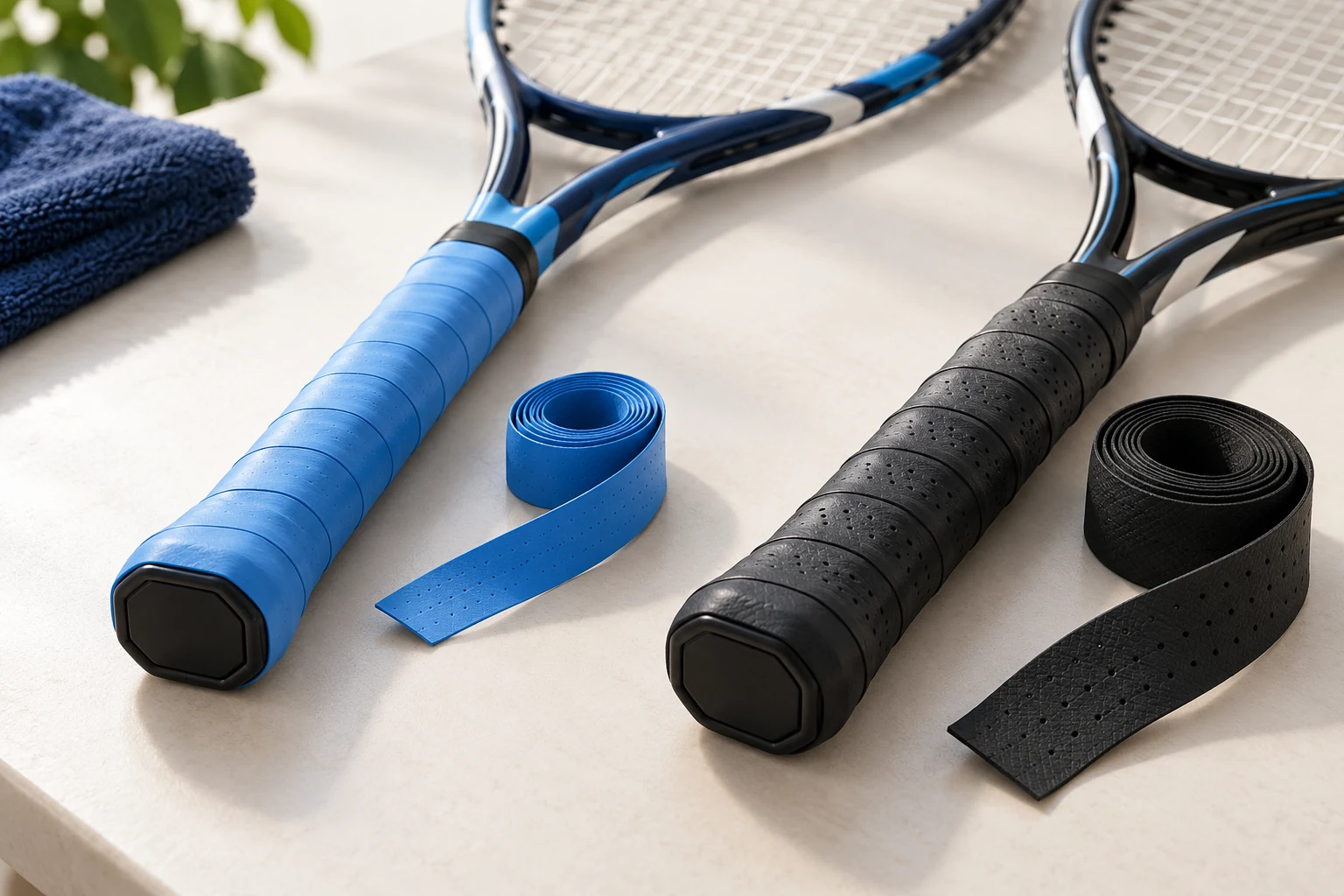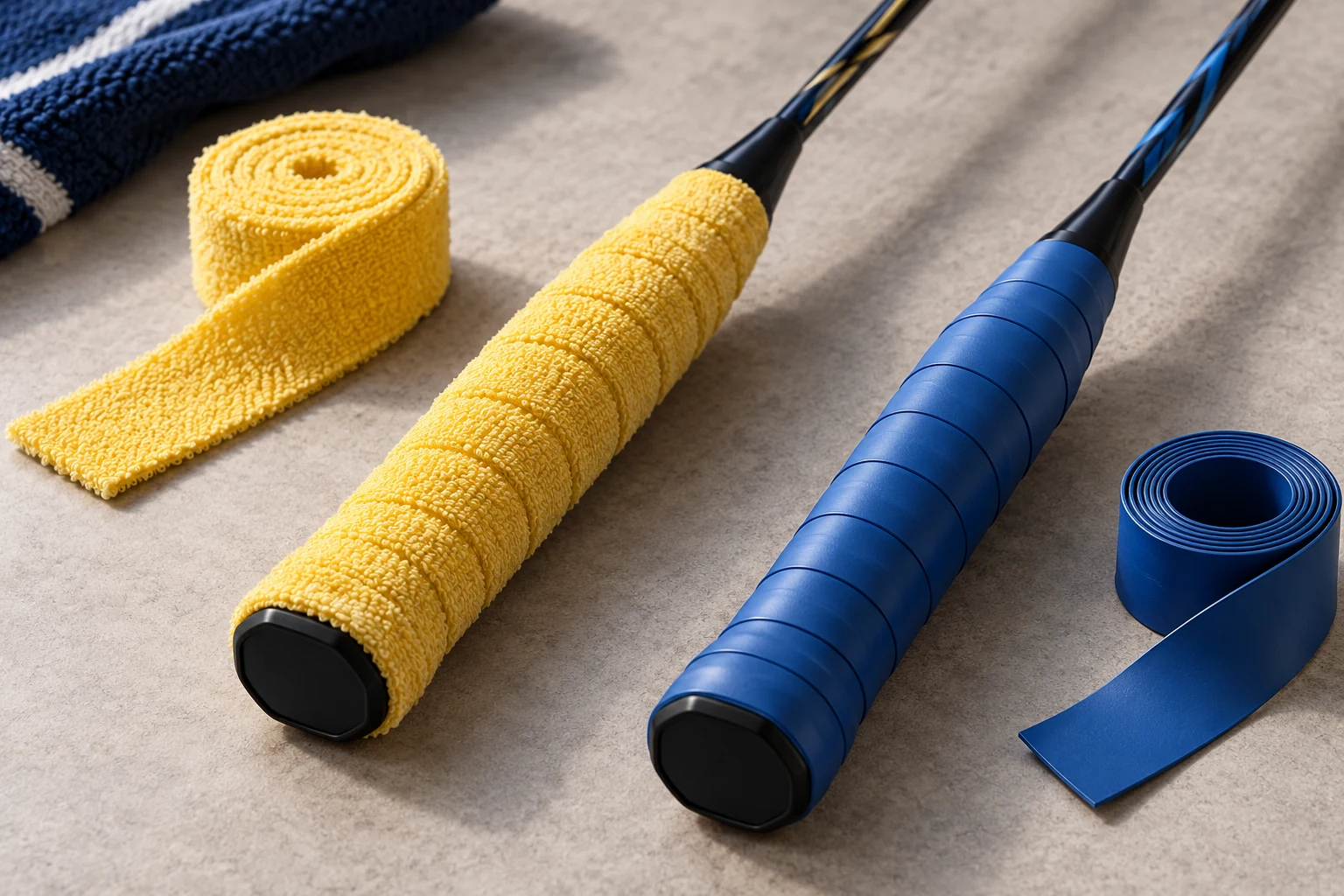
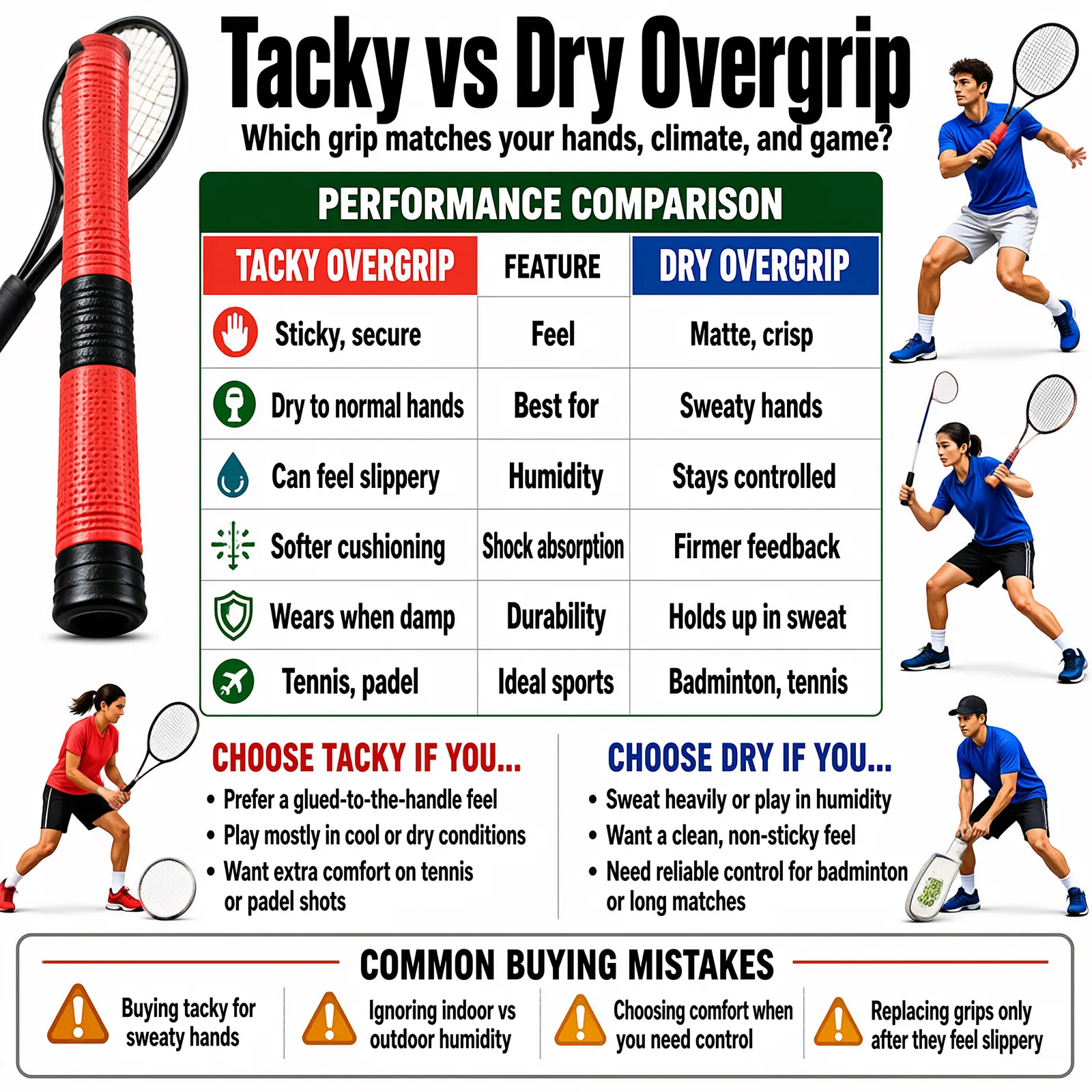
Choosing overgrips for sweaty hands starts with observing the actual use conditions. A surface that feels secure before play may feel different after perspiration, so compare selected samples during a repeatable trial rather than relying only on a tacky or dry label.
This guide focuses on sweat, humidity and player feedback. Use the separate materials guide to identify construction, and the replacement-planning guide to calculate consumption after you have records. No fixed climate threshold decides the best product for every player.
Record what changes during the intended use, rather than selecting from initial feel alone.
Sweat-trial takeaways
- Evaluate a fresh installed sample on the intended racket or paddle.
- Record conditions and surface observations without inventing friction percentages.
- Keep the base grip, overlap and supplied variant consistent across the comparison.
- Use actual customer feedback rather than an assumed regional sales ratio.
- Review material, installation and hand-contact conditions together.
Start with the Player and the Intended Conditions
Describe when the handling problem appears: at the start of play, after perspiration or after repeated use. Include the sport, handle reference and preferred feel so the sample comparison addresses a specific question.
Do not assume that all tacky coatings behave alike, or that all dry-feel wraps absorb moisture in the same way. The selected model and installed arrangement matter. A sample trial can reveal a preference without proving a universal material ranking.
No sweat-simulation dataset is asserted here. Earlier percentages, sample counts and simulated-temperature results lacked a reviewable supporting record; they are replaced by the observation method below rather than new numerical claims.
Control the Installation Before Comparing Sweat Response
Use the same base grip and a consistent wrap method for each sample. Record the supplied dimensions, covered length, overlap and finishing strip so an installation difference is not mistaken for a material advantage.
Check the hand-contact surface before play and again during the intended use. Note any change in feel, whether wiping changes it and whether the handle moves in the hand. Keep material identification separate from these observations.
A casual trial is not a calibrated friction test. Record what the player experienced and the conditions they reported, but do not convert those observations into a coefficient, percentage improvement or guaranteed service duration.
Record Sweat and Climate Observations Consistently
The purpose of this comparison is to identify an acceptable installed sample under relevant conditions. Start with a manageable shortlist and decide beforehand what observations will be recorded for each sample.
Player perspiration, ambient conditions and use intensity can change between sessions. Record those differences and avoid attributing every change to the wrap. Repeat the comparison when the conditions were too different to support a useful decision.
Keep the record attached to the actual SKU and variant. This article does not claim a measured friction-retention result; ask for an appropriate test report if a quantified property is required for your purchasing specification.
- Surface observation: note the initial feel and any change during use.
- Moisture observation: record wetness, wiping and the player’s description.
- Installation observation: check movement, overlap and end fixation.
- Condition observation: record the setting and any relevant changes.
- Decision observation: state what would justify another trial or approval.
A useful sample record identifies the model, installation, conditions and observed handling.
Use a Trial Record, Not an Assumed Performance Matrix
Use the table to record a comparison for the actual equipment and samples. The entries identify information to collect; they do not assign a default pass mark or establish that one commercial surface label is better.
Record material details only when they are known for the selected model. Sweat response cannot be inferred from a broad PU or textile label alone. Keep the supplier’s specification and your own field observations distinguishable.
The trial should support a practical selection decision. It does not establish a measured life in hours, a friction coefficient or a market-wide preference. If those properties are required, agree the test conditions and evidence separately.
| Trial field | First sample | Alternative sample |
|---|---|---|
| Model and variant | Record the actual SKU | Record the actual SKU |
| Initial surface feel | Describe before play | Describe before play |
| Moisture observation | Record during use | Record during use |
| Handling after wiping | Record the observation | Record the observation |
| Installed dimensions | Record the reference | Use the same method |
| Use conditions | Record the session context | Record the session context |
| Supplied format | Confirm strip or roll | Confirm strip or roll |
Turn Player Feedback into a Focused Follow-Up
Players Reporting a Dry Initial Hand
Ask which initial feel the player prefers and whether that preference changes during use. Include alternatives where useful rather than assigning a tacky product automatically from the reported hand condition.
Record the installed thickness and handle reference alongside the surface preference. A sample can feel less secure because the finished handle is unsuitable, even when the surface treatment itself has not changed.
Use the same feedback questions for each sample. This is a local evaluation record, not evidence that customers in all dry regions prefer a particular surface or that one model has a market-wide sales advantage.
Players Reporting Perspiration During Play
Include a sample intended for the requested surface feel and review it under the player’s usual conditions. Record when the handling changes and whether a fresh wrap or revised installation changes the observation.
Check for movement, lifting edges and the finishing arrangement before changing the material specification. A sweat complaint may involve the handle setup as well as the contact surface, so keep both parts of the record.
No retail case study or sales multiplier is claimed here. If a shop is testing alternatives, record its own feedback, returns and repeat requests before deciding how to expand the range.
Shops Serving Different Player Preferences
A shop can compare several clearly identified options without deciding a fixed assortment ratio in advance. Begin with the actual requests and trial feedback received from its customers.
Track each model separately so a popular feel is not confused with a different pack size, price or available color. Climate is relevant context, but it is not sufficient evidence for a universal stock split.
Use the resulting observations to plan the next order. Keep the initial assortment flexible and confirm model combinations and quantities per color with the quotation; no climate-based percentage split is prescribed here.
| Feedback group | What to compare | What to record | How to use the result |
|---|---|---|---|
| Dry initial hand | Selected surface options | Initial and later feel | Choose an acceptable installed sample |
| Perspiration complaint | Selected surface options | Moisture, handling and fixation | Identify the next sample question |
| Mixed shop requests | Clearly identified model options | Requests and repeat orders | Plan the range from actual records |
Specify the Sweat Evaluation in a Sample Brief
Identify Models and the Supplied Unit
List the models, material reference and actual unit you want to compare. A roll and an individual strip are different supplied formats; confirm dimensions and the intended use before requesting a sample selection.
Explain the handling question in plain terms, such as a change in feel after perspiration. Avoid asking for an unspecified product that is simply better in humidity; a clear equipment and use reference makes the response more useful.
Standard products start at 100 units, with up to two colors. Custom projects currently start at 1,000 units; confirm the applicable minimum, model combinations, color quantities and supplied unit in the quotation, without assuming a per-SKU or per-color allocation.
Agree Sample Timing and Evaluation Conditions
Confirm the selected sample availability, quantity, charges, shipping and preparation timing before dispatch. Do not assume that tacky and dry options have a fixed difference in production or sample lead time.
Ask what care, installation and evaluation guidance applies to the proposed model. Record which conditions the trial will cover and what would count as an acceptable observation for your application.
Order timing is confirmed for the actual brief. Material, artwork and packing choices can affect the schedule, but no automatic additional number of days is assigned to a surface category.
Review Branding on the Installed Sample
If branding is part of the project, specify its intended position and review it after wrapping. An acceptable flat-strip print does not automatically remain visible with the selected overlap.
Confirm a suitable print or branding method for the actual material. Do not assume that every PU or textile construction supports the same treatment or that a fixed number of prototype rounds will be sufficient.
Agree the artwork reference, sample evaluation and next approval step with the quotation. This guide does not assert a prototype-success rate or laboratory programme that has not been documented.
- Confirm the selected models, supplied unit and applicable order conditions.
- Confirm preparation and shipping timing for the sample selection.
- Review artwork position and finishing on the installed sample.
- Set the assortment from actual feedback and order records.
- Request supporting records if a quantified performance claim is required.
Avoid Conclusions the Trial Cannot Support
A useful field comparison can identify a suitable sample for the players and conditions observed. It cannot establish that one surface will perform better for every player or every climate.
Do not select from dry-hand feel alone when perspiration is the problem being investigated. Equally, do not assume every reported slip is caused by moisture; check the installation and actual surface condition.
Record the observation rather than an invented crossover time or friction percentage. Where the result is unclear, repeat a controlled comparison or obtain the test evidence needed for your purchasing specification.
- Initial tackiness does not by itself predict handling during perspiration.
- A dry-feel label does not establish the exact material or moisture uptake.
- A local trial does not determine a universal regional sales ratio.
- A worn or poorly installed sample does not fairly represent a fresh installed reference.
Questions About Sweat-Focused Sample Evaluation
Is this guide a material-composition comparison?
Its focus is the evaluation of sweat and use conditions. Use the linked materials guide for construction terminology, then bring the actual model and variant into the trial record.
Which overgrip should I try for sweaty hands?
Shortlist suitable models and compare their installed feel during the intended use. A dry-feel option can be included, but no label alone guarantees the preferred response for every player.
Can the trial establish which surface lasts longer?
Only your recorded use can support a comparison for those models and conditions. This guide does not state a universal lifetime advantage. Use the replacement-planning guide to record the relevant dates, hours and reasons.
Should I stack several outer wraps for sweat control?
Do not assume multiple outer wraps will improve moisture handling. Specify the intended layer arrangement and assess final dimensions and compatibility on the actual handle.
What order and sample terms should I confirm?
Standard products start at 100 units with up to two colors; custom projects currently start at 1,000 units. Confirm applicable minimums, combinations, supplied units, sample quantity, charges, shipping and timing before arranging supply.
Should a shop prescribe a fixed tacky-to-dry stock ratio?
No fixed ratio is supported by this guide. Use customer requests, sample feedback and actual reorder records, then confirm the model and color allocation with the quotation.
Choose the next sample or order from actual feedback rather than a prescribed climate threshold.
Prepare an equipment reference, a labelled sample shortlist and a consistent feedback record. Keep material identity, observed sweat response and replacement consumption as separate decisions, connecting them only when you have records for the actual model and use conditions.